Scenic cruising · New Zealand · Australia & New Zealand
Milford Sound & Fiordland scenic cruising guide
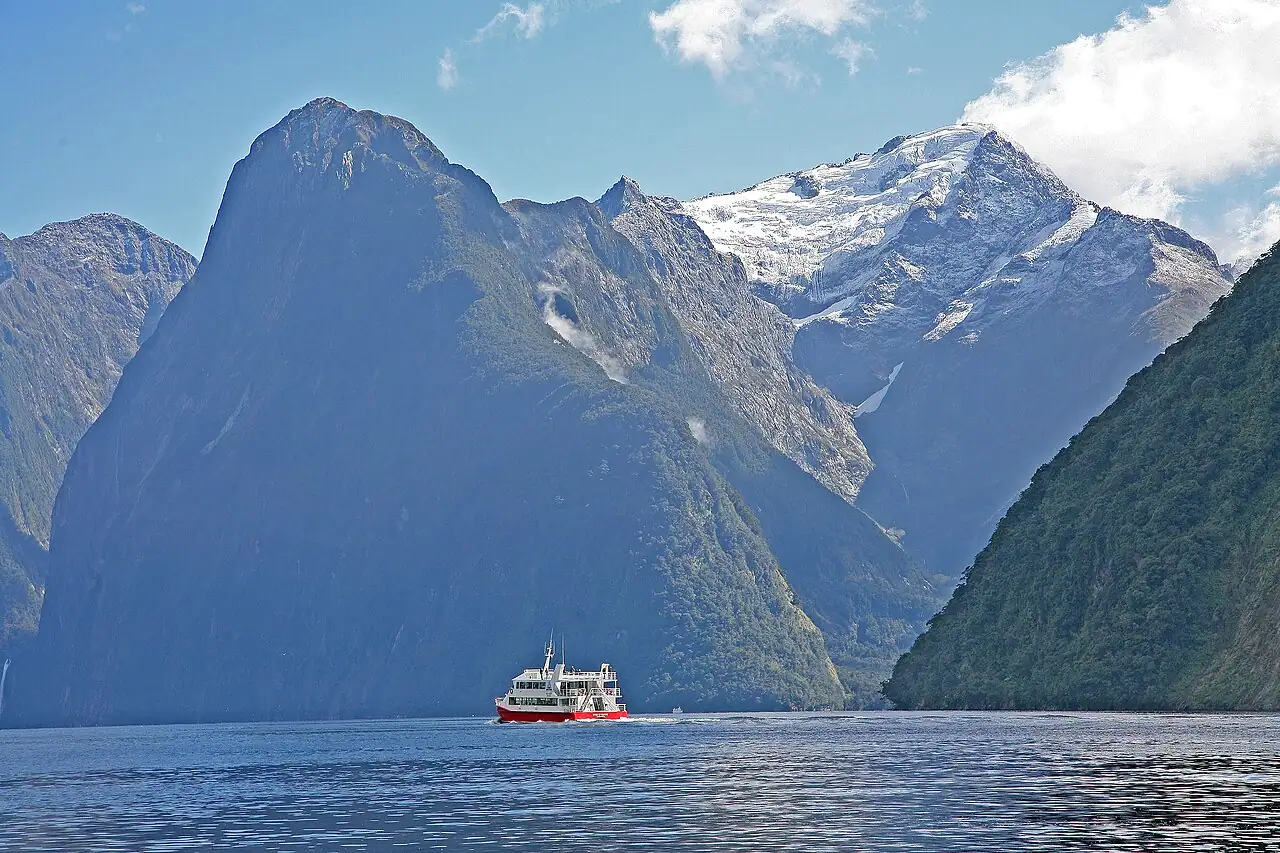
Milford Sound is a scenic-cruising stop, not a port: your ship sails into New Zealand’s most famous fiord in Fiordland National Park and back out again, with no docking or going ashore. Sheer cliffs, Mitre Peak and waterfalls like Stirling Falls are the highlights. Weather can shorten or cancel Fiordland cruising, so treat it as a bonus.
- Fiord scenery
- Waterfalls
- Wildlife spotting
- Photography
Photo: W. Bulach, CC BY-SA 4.0, via Wikimedia Commons
- Country
- New Zealand
- Region
- Australia & New Zealand
- Type of stop
- Scenic cruising
- Language
- English and te reo Māori are New Zealand’s official languages. Commentary on board is in English.
- Currency
- New Zealand dollar (NZD), though you won’t go ashore. Onboard purchases are charged to your cabin account.
- Best time to visit
- January–December
- Average highs
- 51–69°F through the year
About Milford Sound & Fiordland
Milford Sound (Piopiotahi) is a glacier-carved fiord, part of the Te Wāhipounamu World Heritage Area in New Zealand’s southwest. Rock walls soar almost vertically from the waterline, waterfalls pour from hanging valleys, and Mitre Peak stands guard near the entrance.
Many ships also cruise Doubtful Sound or Dusky Sound on the same day, spending a few hours in each. Rain is frequent, but it brings countless temporary waterfalls, so a wet day can be spectacular. Fog, high winds or rough seas can limit visibility or cancel the visit, and the Tasman Sea crossing to and from Australia can be rough.
How the scenic cruising day works
There’s no docking at Milford Sound. Your ship sails in, usually early in the day, cruises slowly toward the head of the fiord, turns and sails out, typically over one to three hours. A local pilot often boards to guide the ship, and some lines offer commentary. Open decks, especially forward areas, give the best views; your line may open extra deck space. Balconies help, but the view switches sides as the ship turns. Weather can affect timing or cancel the visit.
Best things to do in Milford Sound & Fiordland on a cruise
- 1
Mitre Peak
scenery
The iconic peak, about 5,550 feet (1,692 m) high, rises dramatically from the water near the fiord’s entrance. It’s one of New Zealand’s most photographed landmarks, especially when clouds swirl around its summit.
- 2
Stirling Falls
scenery
A powerful waterfall plunging about 500 feet (151 m) from a hanging valley. Ships often edge close enough for spray to reach the decks. In heavy rain, it’s joined by many temporary waterfalls along the cliffs.
- 3
Lady Bowen Falls
scenery
Near the head of the fiord, this tall waterfall provides power and water for the small settlement at Milford. Look for it as the ship turns.
- 4
Seal Rock and wildlife
wildlife
New Zealand fur seals often bask on rocks along the fiord. Bottlenose dolphins sometimes accompany ships, and Fiordland crested penguins may be seen seasonally. Bring binoculars.
- 5
Doubtful Sound
nature
Larger and quieter than Milford, Doubtful Sound (Patea) has a network of arms and islands. Many itineraries include it on the same day, offering a different perspective on Fiordland.
- 6
Dusky Sound
history
Remote Dusky Sound was visited by Captain James Cook in 1773. Its islands and inlets are wild and rarely visited except by ships, making it a special part of Fiordland cruising.
- 7
Deck photography
scenery
Find a spot forward or high up to capture the scale of the cliffs. A wide-angle lens helps, and a lens cloth is essential for spray and rain.
Milford Sound & Fiordland weather by month
| Month | Jan | Feb | Mar | Apr | May | Jun | Jul | Aug | Sep | Oct | Nov | Dec |
|---|---|---|---|---|---|---|---|---|---|---|---|---|
| High °F (°C) | 6920 | 6820 | 6619 | 6116 | 5714 | 5312 | 5111 | 5312 | 5613 | 5915 | 6317 | 6619 |
| Low °F (°C) | 5613 | 5513 | 5412 | 5110 | 489 | 457 | 436 | 447 | 457 | 478 | 5010 | 5412 |
| Rain in (mm) | 7.6194 | 7.2182 | 6.8172 | 7.6192 | 7.6194 | 6.2157 | 7.7196 | 6.9174 | 7.8199 | 8.1206 | 6.9176 | 7.6192 |
| Daylight (hrs) | 15 | 14 | 13 | 11 | 10 | 9 | 9 | 10 | 12 | 13 | 15 | 16 |
What to eat and drink in Milford Sound & Fiordland
There’s no going ashore, so meals are on board. Many lines mark the day with New Zealand touches such as lamb, green-lipped mussels or a glass of Central Otago pinot noir or Marlborough sauvignon blanc. Hot drinks on deck help on cool mornings. Eat breakfast early or grab something portable so you don’t miss the sail-in.
Tips for your port day
- Wake early; ships often enter Fiordland soon after sunrise.
- Dress in warm, waterproof layers; it’s cool and windy on deck.
- Bring binoculars and a camera with a wide-angle lens.
- Expect weather to affect the visit; rain makes waterfalls more dramatic.
- If you’re prone to seasickness, prepare for the Tasman Sea crossing.
Cruise lines that visit Milford Sound & Fiordland
Often on the same itinerary
Milford Sound & Fiordland cruise FAQs
Can you get off the ship at Milford Sound?
No. Milford Sound is a scenic-cruising stop with no docking or tendering. You view it from the ship.
What happens if the weather is bad at Milford Sound?
The captain may shorten, reroute or cancel the visit if fog, wind or seas make it unsafe. Rain alone usually doesn’t stop it, and it creates extra waterfalls.
How long do cruise ships spend in Milford Sound?
Typically one to three hours, depending on the itinerary and conditions. Many ships also visit Doubtful or Dusky Sound on the same day.
Which side of the ship is best for Milford Sound?
Both sides get views as the ship turns. Open forward decks give the widest views; balconies help but see one side at a time.
Is Milford Sound worth it on a cruise?
Yes. It’s one of the world’s most dramatic fiords, and seeing it from a ship gives a unique perspective, even in rain.
Updated November 2026 by the BookMyDreamCruise editorial team. How we research and fact-check.
Sources: Wikipedia, Wikidata, NASA POWER climate data.