Best time to cruise · Best time to go
Hawaii cruises in February
February continues peak whale-watching, and Maui’s whale festival season keeps the harbors busy with boats. Temperatures sit in the upper 70s to low 80s °F, with cooler evenings and passing showers. Presidents’ Day week and Valentine’s getaways push up demand on Pride of America sailings, so reserve early.
- Best time to go
- Avg high 69°F
- 11 hrs daylight
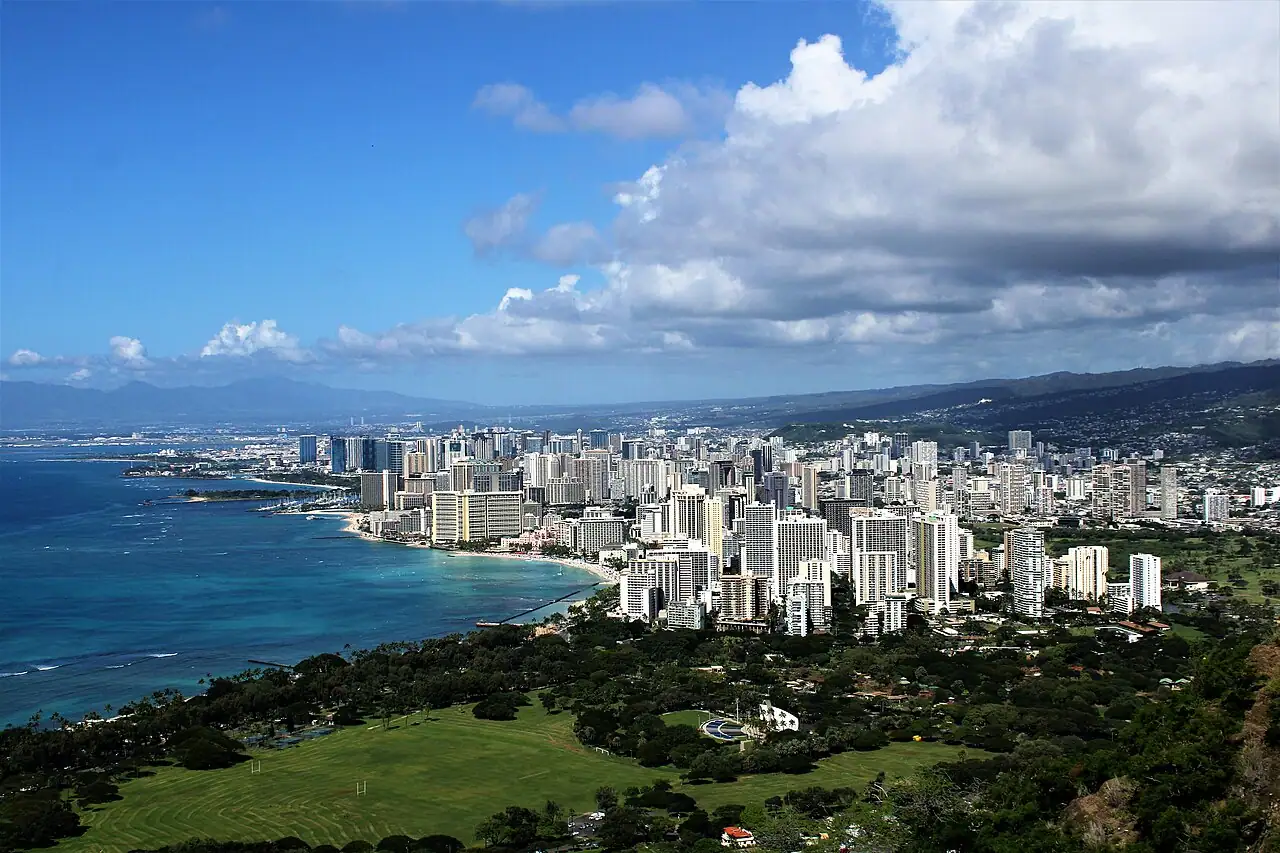
Photo: Farragutful, CC BY-SA 4.0, via Wikimedia Commons
Hawaii in February: Best time to go
February continues peak whale-watching, and Maui’s whale festival season keeps the harbors busy with boats. Temperatures sit in the upper 70s to low 80s °F, with cooler evenings and passing showers. Presidents’ Day week and Valentine’s getaways push up demand on Pride of America sailings, so reserve early.
Across Hawaii cruise ports, February brings average highs around 69°F (20°C) and lows near 61°F, with about 3.7 inches of rain over the month and roughly 11 hours of daylight.
- Verdict
- Best time to go
- Season
- Year-round; humpback whales December to April. Best weather-and-value months April to May and September to October.
- Average high / low
- 69°F / 61°F
- Rainfall (month)
- 3.7 in
- Daylight
- About 11 hours
- Typical cruise length
- 7 nights inter-island from Honolulu; 14 to 17 nights from the West Coast
What to pack: warm-weather clothes with layers: shorts and light pants, a sweater or light jacket for breezy evenings on deck, and comfortable walking shoes.
How February compares with the rest of the year
- Jan: Best time to go
- Feb: Best time to go
- Mar: Best time to go
- Apr: Good time to go
- May: Best time to go
- Jun: Good time to go
- Jul: Good time to go
- Aug: Good time to go
- Sep: Best time to go
- Oct: Good time to go
- Nov: Good time to go
- Dec: Good time to go
- No regular sailings
- Shoulder season
- Good time to go
- Best time to go
Hawaii weather in February
| Month | Jan | Feb | Mar | Apr | May | Jun | Jul | Aug | Sep | Oct | Nov | Dec |
|---|---|---|---|---|---|---|---|---|---|---|---|---|
| High °F (°C) | 6920 | 6920 | 7021 | 7222 | 7424 | 7825 | 8027 | 8127 | 8027 | 7826 | 7323 | 6921 |
| Low °F (°C) | 6217 | 6116 | 6217 | 6418 | 6619 | 6820 | 7122 | 7222 | 7122 | 6921 | 6619 | 6217 |
| Rain in (mm) | 4.1103 | 3.793 | 4.3110 | 3.075 | 2.255 | 1.539 | 1.334 | 1.947 | 2.152 | 2.974 | 3.897 | 4.6116 |
| Daylight (hrs) | 10 | 11 | 12 | 13 | 14 | 14 | 14 | 13 | 12 | 11 | 11 | 10 |
February weather port by port
| Port | Avg high | Avg low | Rain | Daylight |
|---|---|---|---|---|
| Honolulu | 77°F | 72°F | 3.7 in | 11 h |
| Kahului (Maui) | 76°F | 72°F | 2.6 in | 11 h |
| Hilo | 78°F | 71°F | 5.2 in | 12 h |
| Kona (Kailua-Kona) | 77°F | 75°F | 3.7 in | 12 h |
| Nawiliwili (Kauai) | 76°F | 72°F | 2.9 in | 11 h |
| Los Angeles | 64°F | 56°F | 2.8 in | 11 h |
| San Diego | 70°F | 53°F | 1.9 in | 11 h |
| San Francisco | 60°F | 46°F | 3.3 in | 11 h |
| Vancouver | 42°F | 33°F | 7.0 in | 10 h |
Average daily highs and lows, 2015–2024, from NASA POWER, adjusted to sea level. Rain is the average monthly total.
Other great cruise destinations in February
- Caribbean in February
- Eastern Caribbean in February
- Western Caribbean in February
- Southern Caribbean in February
- Mexican Riviera & Baja in February
- Panama Canal & Central America in February
- South America in February
- Galápagos Islands in February
- Canary Islands & Atlantic Isles in February
- Antarctica in February
See every destination for February, with a port weather map →
Hawaii in February: FAQs
Is February a good time to cruise Hawaii?
Yes, it's one of the best months. February continues peak whale-watching, and Maui’s whale festival season keeps the harbors busy with boats. Temperatures sit in the upper 70s to low 80s °F, with cooler evenings and passing showers. Presidents’ Day week and Valentine’s getaways push up demand on Pride of America sailings, so reserve early.
What is the weather like on a Hawaii cruise in February?
Across Hawaii cruise ports, February brings average highs around 69°F (20°C) and lows near 61°F, with about 3.7 inches of rain over the month and roughly 11 hours of daylight. Conditions vary from port to port and day to day.
What should I pack for a Hawaii cruise in February?
Pack warm-weather clothes with layers: shorts and light pants, a sweater or light jacket for breezy evenings on deck, and comfortable walking shoes. Check your cruise line's dress code for evenings.
When is the best time to cruise Hawaii?
Year-round; humpback whales December to April. Best weather-and-value months April to May and September to October.. The best months are usually January, February, March, May, September.
Where else can I cruise in February?
February is also a top month for Caribbean, Eastern Caribbean, Western Caribbean, Southern Caribbean, Mexican Riviera & Baja.
Updated November 2026 by the BookMyDreamCruise editorial team. How we research and fact-check.
Sources: NASA POWER climate data.