Cruise port · Japan · Japan
Nagasaki cruise port guide
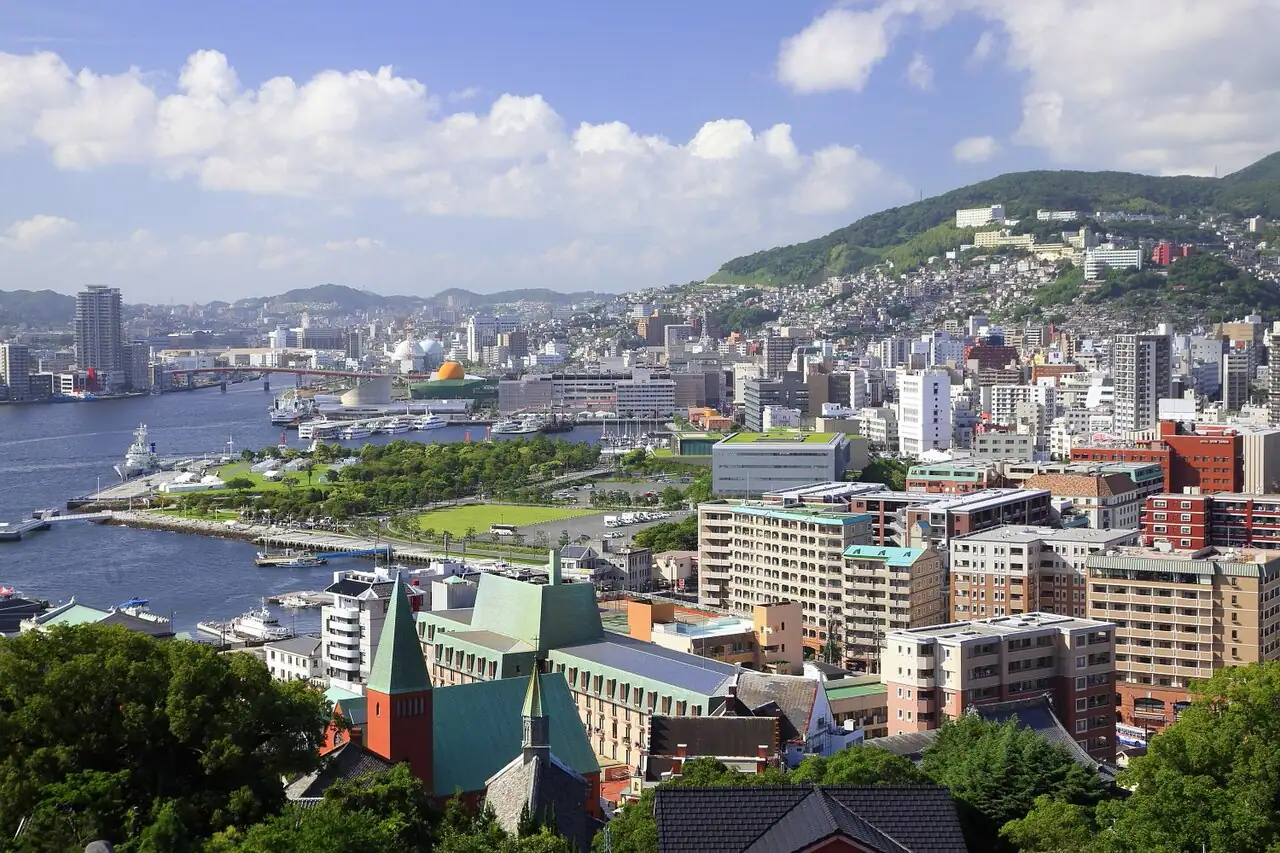
Nagasaki is a hilly, harbor-wrapped city where ships dock close to the center and streetcars reach almost everything. The main draws are the Atomic Bomb Museum and Peace Park, the historic Dutch trading post at Dejima, Glover Garden’s hillside views and boat trips to Gunkanjima, the abandoned “Battleship Island.”
- WWII history
- Walkable sightseeing
- Gunkanjima
- Champon noodles
- Christian heritage
Photo: Tomio344456, CC BY-SA 4.0, via Wikimedia Commons
- Country
- Japan
- Region
- Japan
- Type of stop
- Cruise port
- Language
- Japanese. Main sights have English signage and audio guides, and streetcar stops are announced in English.
- Currency
- Japanese yen (¥). Cards are accepted at larger shops and attractions; carry cash for streetcars, small eateries and shrines.
- Best time to visit
- March–November
- Average highs
- 53–87°F through the year
About Nagasaki
For more than two centuries, when Japan was largely closed to the outside world, Nagasaki was its window to Europe and China. Portuguese missionaries, Dutch traders at Dejima and a large Chinese community all left their mark, so the city has churches, Chinese temples and Western mansions you won’t see elsewhere in Japan. Then on August 9, 1945, it became the second city struck by an atomic bomb, and that history is told with great care at the Peace Park and museum.
A good port day mixes the two sides: a morning at the Atomic Bomb Museum and the hypocenter, then lunch in Chinatown and an afternoon wandering Glover Garden and Oura Cathedral above the harbor. The city is steep, so expect slopes and stairs, but streetcars connect the main areas cheaply and frequently.
Nagasaki is rewarding for history-minded travelers and anyone who wants a manageable city on their own. Those looking mainly for beaches or nightlife will find it quiet.
Where cruise ships dock in Nagasaki
Larger ships usually berth at the Matsugae International Terminal on the harbor, close to the city center. From there, Glover Garden and Oura Cathedral are about a 10 minute walk uphill, Dejima and Chinatown are 15 to 20 minutes on foot, and the Peace Park and Atomic Bomb Museum are about 20 minutes north by streetcar. Streetcars are a flat fare and easy to use, and taxis are plentiful at the terminal. Most visitors can see the main sights independently in one full port day.
Best things to do in Nagasaki on a cruise
- 1
Nagasaki Atomic Bomb Museum and Peace Park
history
The museum tells the story of the bombing and its aftermath through photographs, recovered objects and survivor testimony. It’s moving and, at times, difficult to see. Nearby, a black monolith marks the hypocenter, and the Peace Park has the large Peace Statue. Allow about two hours for both.
- 2
Glover Garden and Oura Cathedral
history
On the hill above the port, Glover Garden preserves the homes of 19th-century Western merchants, including Scottish trader Thomas Glover, with harbor views and moving walkways up the slope. Oura Cathedral, just below, is Japan’s oldest standing church and part of a UNESCO site recognizing the country’s Hidden Christian heritage.
- 3
Dejima
history
This fan-shaped artificial island was the Dutch trading post during Japan’s era of isolation. Reconstructed warehouses, offices and living quarters show how the traders lived. It’s flat, compact and an easy hour from the port.
- 4
Gunkanjima (Battleship Island)
adventure
Hashima, better known as Gunkanjima, is an abandoned coal-mining island whose concrete apartment blocks give it the outline of a warship. Boat tours leave from the Nagasaki harbor area and, when seas allow, land visitors on a viewing walkway. Landings are often canceled in rough weather, and tours sell out, so book ahead.
- 5
Mount Inasa
scenery
A ropeway climbs Mount Inasa for a panoramic view over the harbor and city. It’s best known for its night view, so if your ship stays late or overnights, go after dark. In daytime, it’s still the best way to understand Nagasaki’s dramatic setting.
- 6
Shinchi Chinatown and Megane Bridge
food
Shinchi Chinatown is a compact, colorful few blocks of restaurants and snack shops, perfect for a champon lunch. A short walk away, Megane Bridge, the “Spectacles Bridge,” is a stone arch over the Nakashima River whose reflection forms a pair of glasses. Look for heart-shaped stones in the riverbank wall.
Nagasaki weather by month
| Month | Jan | Feb | Mar | Apr | May | Jun | Jul | Aug | Sep | Oct | Nov | Dec |
|---|---|---|---|---|---|---|---|---|---|---|---|---|
| High °F (°C) | 5312 | 5513 | 6016 | 6719 | 7323 | 7826 | 8429 | 8731 | 8328 | 7524 | 6619 | 5614 |
| Low °F (°C) | 468 | 468 | 5111 | 5714 | 6418 | 7021 | 7825 | 8027 | 7524 | 6719 | 5915 | 4910 |
| Rain in (mm) | 3.077 | 3.897 | 5.6143 | 7.1181 | 9.9251 | 16.9430 | 15.6397 | 11.3288 | 9.9252 | 4.6116 | 4.4112 | 3.075 |
| Daylight (hrs) | 10 | 11 | 12 | 13 | 14 | 14 | 14 | 13 | 12 | 11 | 10 | 10 |
What to eat and drink in Nagasaki
Nagasaki champon is the city’s signature dish: thick noodles in a rich pork-and-chicken broth piled with seafood, pork and vegetables. Its cousin, sara udon, serves crispy fried noodles topped with a similar thick sauce. Kakuni manju, soft buns stuffed with braised pork belly, make a great snack. For dessert or a souvenir, castella, a honey sponge cake introduced by the Portuguese, is sold all over town. Toruko rice, a hearty plate of pilaf, pork cutlet and spaghetti, is a local comfort-food curiosity.
Tips for your port day
- Buy a one-day streetcar pass or use an IC card; the streetcar network covers almost every sight and saves your legs on the hills.
- Book Gunkanjima tours as early as possible, and have a backup plan in case rough seas cancel the landing.
- Visit the Atomic Bomb Museum in the morning before tour groups arrive; it’s a heavy experience, so leave time afterward for a quiet walk in the Peace Park.
- Wear comfortable shoes with grip. Nagasaki is built on steep hills, and many lanes are sloped stone.
- Summer is hot and humid, and typhoons can affect late-summer calls, so carry water and a light rain layer.
Cruise lines that visit Nagasaki
Often on the same itinerary
Nagasaki cruise FAQs
Can you walk from the Nagasaki cruise terminal to the sights?
Yes, to many of them. Glover Garden is about 10 minutes uphill and Dejima about 15 to 20 minutes on foot. For the Peace Park, take the streetcar, about 20 minutes.
How long do you need at the Nagasaki Atomic Bomb Museum?
About 1 to 1.5 hours, plus another 30 to 45 minutes for the hypocenter and Peace Park. It’s emotionally heavy, so many visitors plan something lighter afterward.
Can you visit Battleship Island on a cruise stop?
Often, yes. Tours take about three hours, and several operators leave from the harbor near the cruise terminal. Book ahead, and know that landings are canceled when seas are rough.
Is Nagasaki worth visiting on a cruise?
Yes. It combines important WWII history, a unique trading-port heritage and easy logistics, since ships dock close to town and streetcars reach every major sight.
What is Nagasaki famous for food-wise?
Champon noodles above all, plus sara udon, braised pork belly buns and castella sponge cake. Chinatown is the easiest place to try champon.
Updated November 2026 by the BookMyDreamCruise editorial team. How we research and fact-check.
Sources: Wikipedia, Wikidata, NASA POWER climate data.